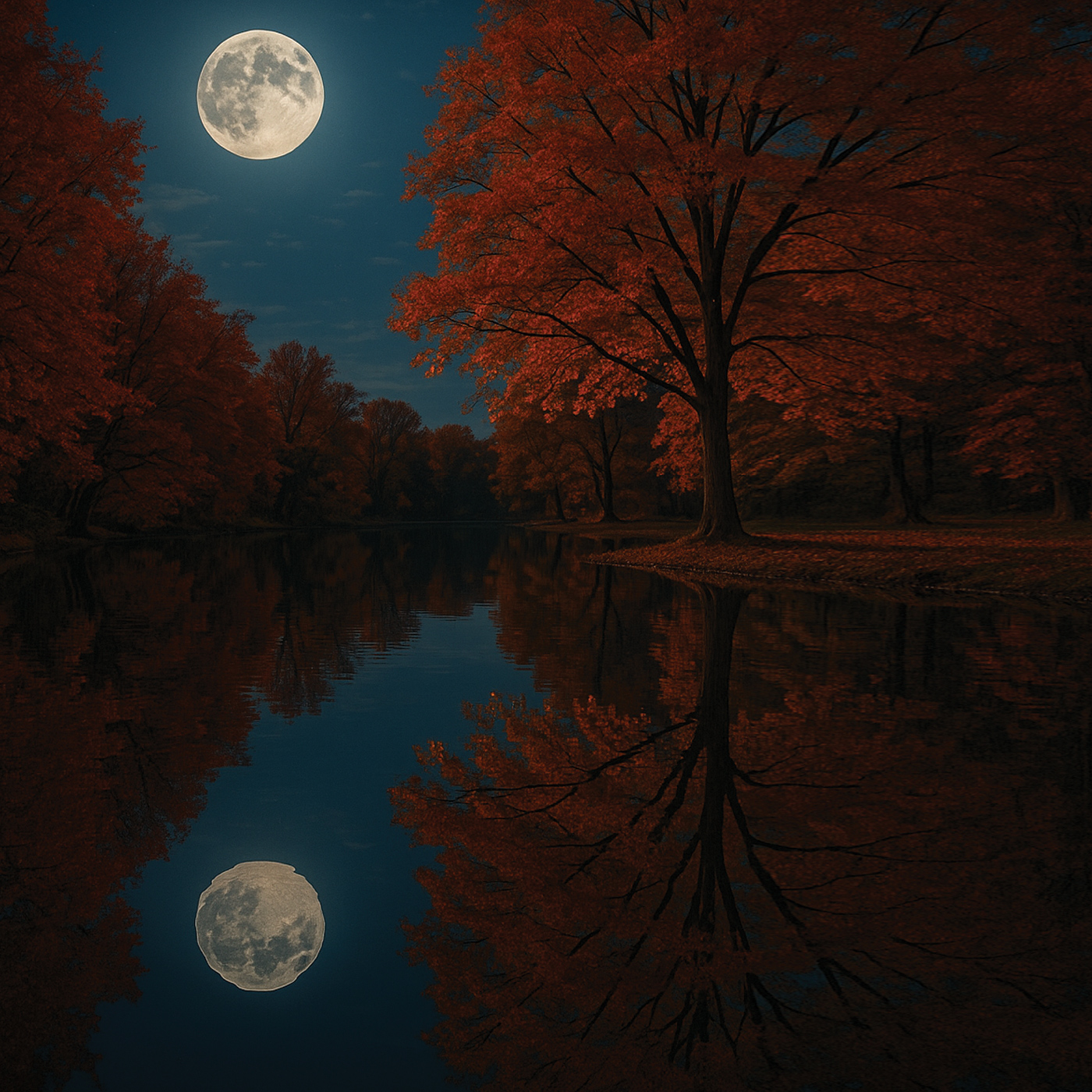
The moon rose clean and bright, a coin set carefully on the lake. The trees bowed toward it, their copper leaves whispering as if they knew a password I did not. I followed the narrow dock until wood met water and the night took my reflection in.
Somewhere across the shoreline a single owl tested the air. I answered with silence and a steady breath. The surface stilled. Moon above, moon below—two doors, one world; step through either and you return changed.
I unspooled a small paper boat from a page torn out that morning, a list of plans already outgrown. I set it on the black glass and watched the ink drink the sky. The boat turned once, chose a path the way leaves choose wind, then drifted toward the bright seam where reflection met the real.
Along the bank the maples kept time with the soft lap of water. I could swear the forest was counting—one, two, three—then letting go on four, as if the whole night ran on a rhythm just under hearing. I tapped the dock with my heel. The lake answered with a quiet bar of ripples, and the moon wavered like a promise reconsidered.
When the paper boat crossed the silver path, it did not sink. It simply thinned into light, as though the lake had been waiting to read it. The owl fell silent. The trees stood taller. Somewhere, a new wind chose me.
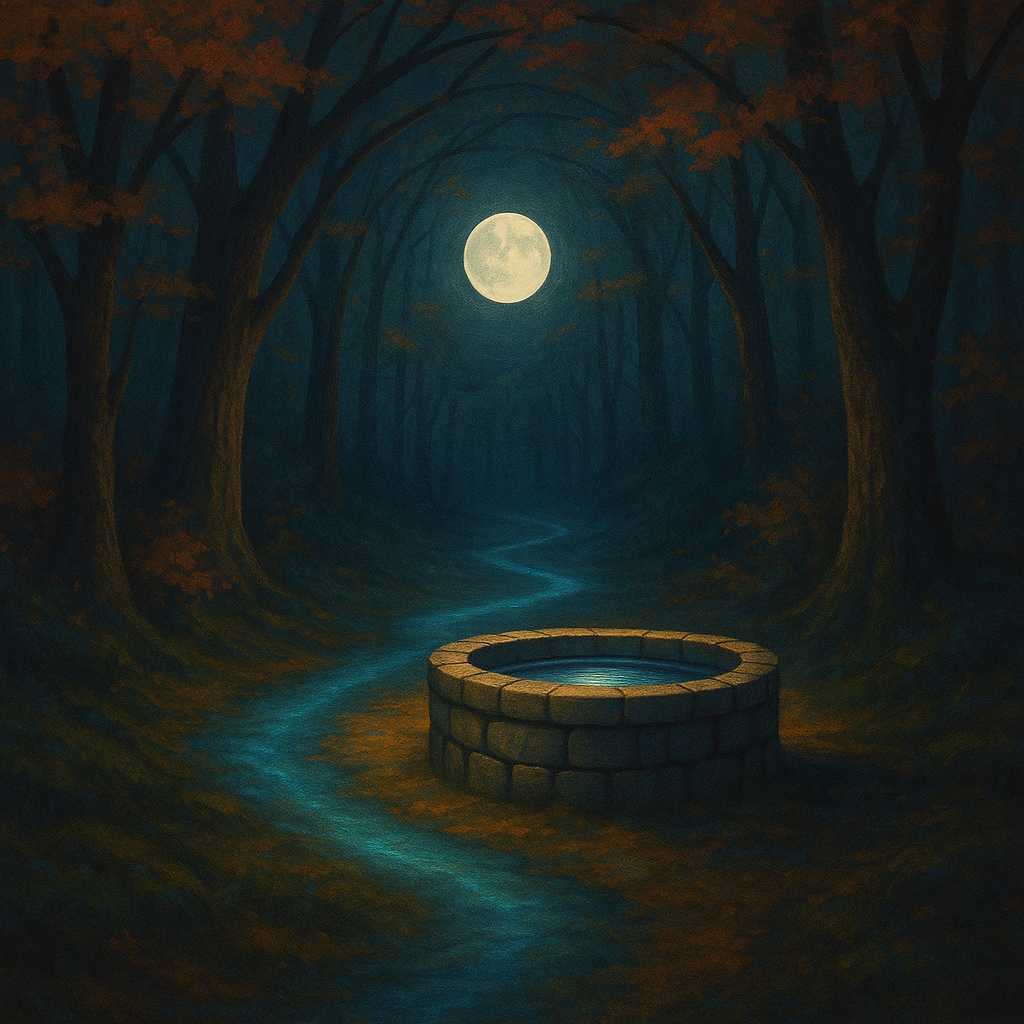
Dawn was still hours away, but the path ahead glowed with a faint, root-deep shimmer— as though the forest had borrowed a little moonlight and hidden it under the moss. I followed the pulse of it, soft and patient, like footsteps I hadn’t taken yet.
The air grew warmer the farther I walked. Not summer warm, but the kind that comes from intention—like someone had opened a door in the world and was holding it just long enough for me to enter. Branches arched overhead, weaving a slow spiral of silhouettes that tightened with every step.
At the center of the spiral stood a stone well, waist-high, rim smoothed by more hands than mine. No rope. No bucket. Just a clear surface inside, still as polished obsidian. Moon above, moon below—again—but this time the reflection waited, expectant, as if trying to decide whether it recognized me.
I leaned closer. The water brightened. It wasn’t a mirror now but a corridor, the same silver seam the paper boat had taken—only wider, deeper, shaped by choice instead of chance. For a moment I felt the night hold its breath. Even the insects paused.
A ripple formed along the edge, concentric and slow, like the start of a long-mixed track easing into a new phase. The shine reached up the stone, brushing my fingertips. It felt cool, but carried a quiet instruction: not yet. listen first.
From somewhere beyond the treeline, a low hum gathered—steady, warm, unmistakably rhythmic. It vibrated through the moss, up through my shoes, into my chest. The night had grown a heartbeat. Or maybe it had always had one and I had finally arrived on the right beat.
I stepped back from the well. The shimmer faded to a beckoning glow. Whatever waited beneath that surface wanted a traveler ready to hear the next bar. So I stood beneath the turning leaves, listening, letting the forest teach me its tempo, until I knew the moment to continue would come on the downbeat.
The downbeat arrived like a soft falling leaf—quiet, but sure of its place in the measure. The hum shifted, widening into layered tones that folded over each other, the way melodies do when a DJ raises a second channel without touching the fader yet. The forest didn’t just sound alive now; it sounded arranged.
As the rhythm settled, the glow from the well stretched outward in thin silver lines, threading through the moss like veins. They didn’t point in one direction—they flowed in all directions, branching like choices I hadn’t spoken aloud.
One path brightened.
Not forcefully. Not urgently. Just… confidently. Like it knew something about me I hadn’t admitted yet.
I followed.
The ground beneath my feet felt different here—springy, almost responsive. Each step sent a soft thrum through the roots, and the roots answered back, echoing the note a half-beat later. A call and response. A conversation I hadn’t realized I was capable of having.
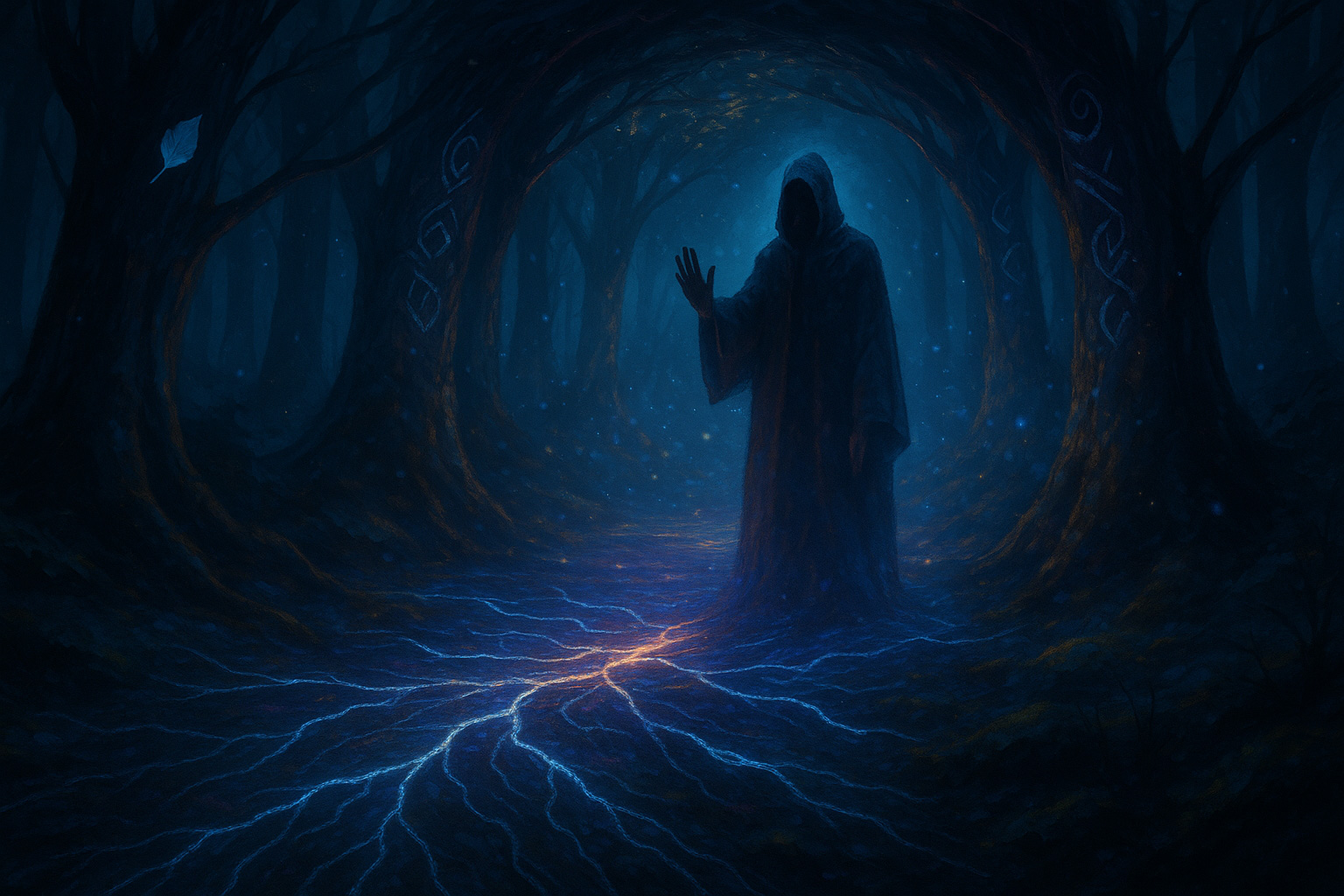
Ahead, the trees leaned inward, forming an archway. Their bark held faint patterns—swirls, crescents, lines that looked less like knots and more like handwriting. As I approached, the markings rearranged themselves into a symbol I recognized from nowhere and everywhere at once: a circle split by a rising diagonal, like a turntable pitch fader frozen mid-shift.
Warm light spilled from beyond the arch.
I stepped through.
The forest opened into a clearing lit from below, as if someone had tucked a constellation under the ground. Tiny motes drifted in the air—lazy, luminous, unbothered by gravity. They pulsed gently, syncing with the hum now rolling in slow waves through the space.
At the center of the clearing stood a figure.
Not human. Not exactly.
Tall, with the posture of someone who’d spent a lifetime listening. Cloaked in something that wasn’t quite fabric and wasn’t quite light—more like woven dusk. Their face was obscured, but not hidden. Shapes shifted where features should be, like an unrendered reflection waiting to learn me before showing itself.
They raised a hand toward me—palm open, fingers relaxed. A greeting. An invitation.
“You heard it,” a voice murmured. I couldn’t tell if it came from them or from everywhere at once. “You followed the tempo.”
The lights dimmed around us, focusing to a single soft spotlight from nowhere.
“What comes next,” the voice continued, “is chosen, not given.”
They stepped aside, revealing another pathway behind them—this one shimmering with the same corridor-silver I’d seen in the well. But the glow thrummed with a new pattern now, one that matched the rhythm I’d felt in my own chest since entering the clearing.
A recognition.
A sync.
The figure tilted its head, as if listening for something only I could decide.
“Are you ready for the next measure?”
The path brightened, waiting for my answer.
I didn’t answer right away. Not because I doubted, but because the moment felt like the breath held between a breakbeat and the drop.
The figure waited, patient as a metronome between worlds. A low tremor rolled through the clearing, subtle but directional, like something beneath us had just been cued up. The drifting motes shifted, arranging themselves into faint lines— staff notation without notes, waiting to be written on.
I stepped toward the path. Not boldly. Not hesitantly. Just honestly. The silver corridor unfurled under my foot, rippling outward like water lit from below.
The rhythm inside it wasn’t just sound—it was architecture. Measures nested within measures, bars subdividing like geometric fractals, snapping into place with mathematical grace.
I understood suddenly: this place wasn’t built. It was sequenced.
As I walked, faint sounds layered into the hum—resampled fragments I recognized: laughter, tires on pavement, the hum of fluorescent lights, a single guitar note plucked too hard on an instrument that never stayed in tune.
Memory as percussion. History as ambience. They didn’t play all at once—they triggered at each step, as though my presence activated them.
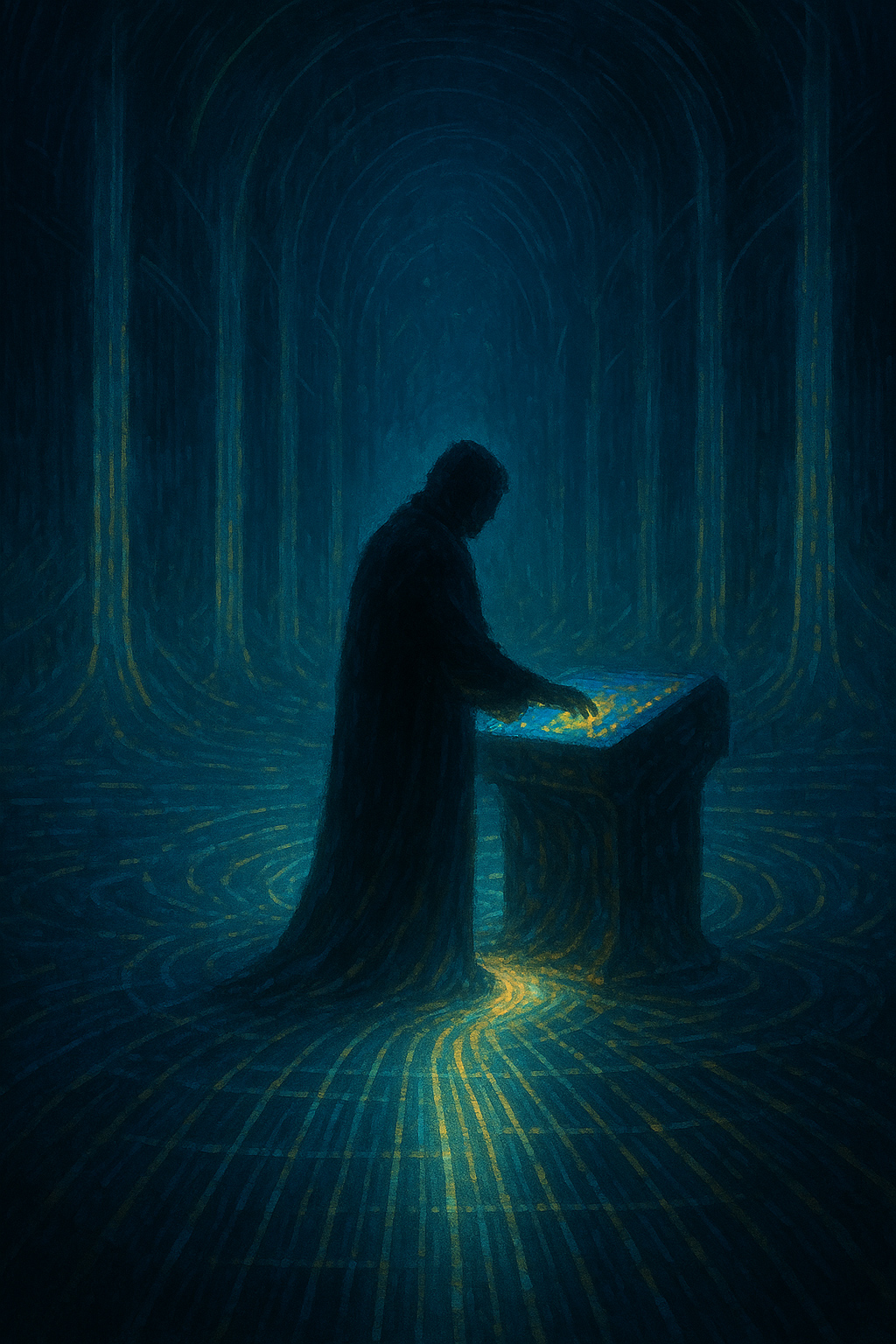
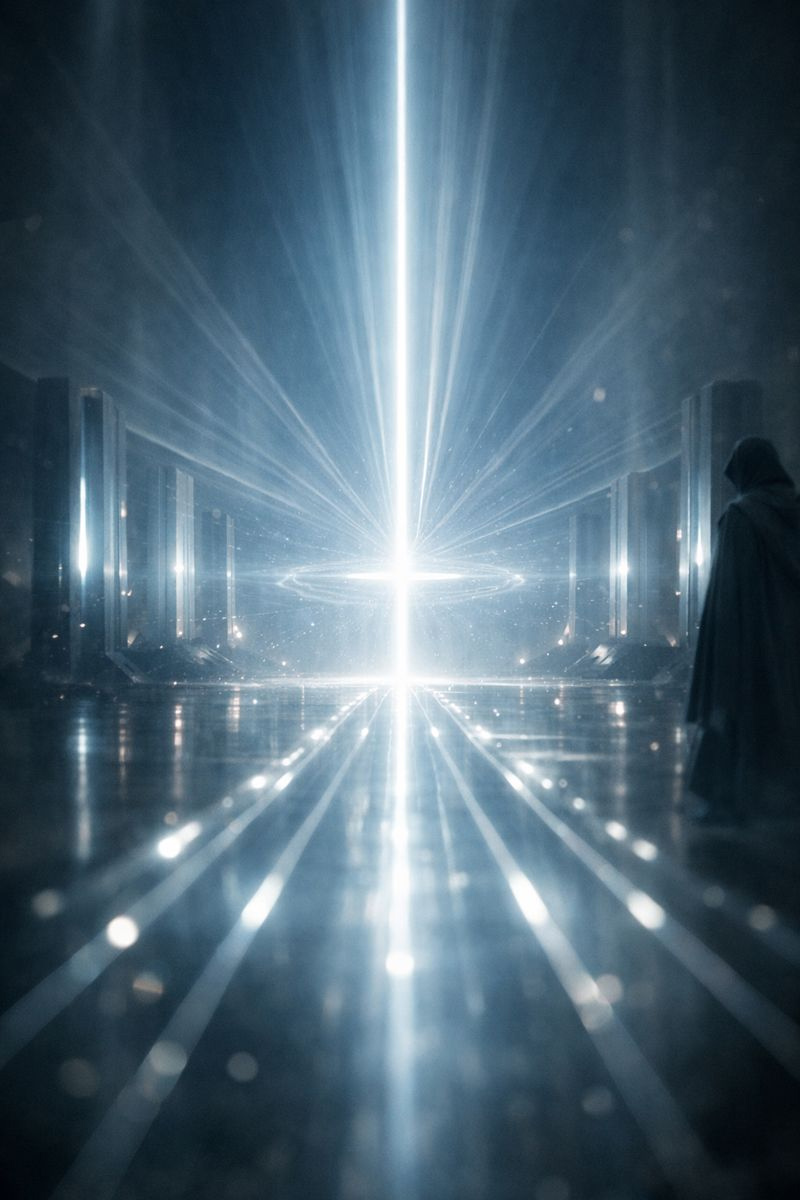
The corridor opened into a chamber where columns of light stood like speakers frozen mid-reveal. Lines spiraled up each one, bending gently with a soft wind that moved through the space.
At the center, a console emerged from the ground—half-stone, half-interface. Its surface pulsed with slow, syncopated color.
“This is the measure between measures,” the voice said, clearer now—shaped into tone rather than whisper. “A prelude. A rehearsal. A place to discover the rhythm you carry, not the rhythm you obey.”
I reached out, fingers hovering above the console. Heat rose from it—not burning, just insistent. A vibration mapped itself through my arm, tracing veins like rerouted circuitry.
“What happens if I touch it?” I asked.
“The sequence becomes yours,” they replied. “Not perfect, not finished—just truthful. And once rhythm becomes truth, it cannot be unheard.”
“And if I don’t?”
“Then the measure will close. Silently. Without blame. You will return with memory, but without momentum.”
Memory without momentum. Sound without motion. A track with no drop. I set my hand down.
Light flickered across the surface in a burst—bright enough to erase color but not shape. Lines raced outward, connecting the columns, mapping the chamber like a sequencer grid exploding into life.
The hum shifted into rhythm—my rhythm—imperfect, syncopated, aching toward resolution.
And beneath that pulse, I heard something unfamiliar yet unmistakable: a voice I recognized as my own, older, asking, “What will you build with this time?”
I lifted my head, feeling the next measure forming, waiting to be named. “Play it in.”

The moment my palm met the console, the chamber exhaled. Not air—signal.
Light spilled outward in clean, deliberate lines, slicing the space into overlapping planes. The columns responded first, pulsing in staggered intervals, as if testing latency. The hum broke apart—not collapsing, but resolving into components I could finally distinguish.
Bass, low and patient, rolled beneath everything—grounding. Above it, a lattice of midrange tones braided together, imperfect but alive. And high above that, a thin, crystalline thread hovered, trembling with potential.
The console brightened again. Symbols surfaced—some familiar, some alien, all moving. Not buttons. Not controls. Invitations.
I realized then this wasn’t an interface meant to be mastered. It was meant to be *entered*.
I pressed my hand down fully.
The chamber fractured—not violently, but rhythmically—like a track splitting into stems. Walls pulled apart into transparent layers, revealing versions of the clearing stacked in time.
One layer showed the forest as it had been moments ago. Another shimmered with unfamiliar growth—structures woven into the trees, light running where sap once flowed. And below that, faint but undeniable, a city glowed—angular, breathing, listening upward.
The figure reappeared beside me, closer now. “This is the first transmission,” they said. “You are no longer listening. You are broadcasting.”
“To where?” I asked.
“To when.”
The crystalline thread tightened, pulling gently at my chest. I felt it then—the cost. Each measure I shaped here would echo outward, altering what followed. Not rewriting. Redirecting.
Somewhere, something slipped out of sync.
The bass faltered for half a beat. The lattice bent. A hairline crack traced itself across the air, luminous and slow.
The figure turned their head sharply, listening.
“You weren’t alone in hearing the signal,” they said.
The crack widened. From it came a counter-rhythm—familiar, insistent, slightly out of phase.
Not silence. Interference.
The console dimmed, waiting. The next choice wouldn’t be about sound. It would be about alignment.
The interference didn’t get louder. It got smarter.
The crack in the air held its shape like a held note, but the rhythm inside it kept shifting—micro-delays, subtle swings, a pulse that tried to sound like mine without ever landing clean.
The chamber answered with a low corrective thrum, the way a sound system does when it senses feedback. The columns of light dimmed and brightened in a pattern that felt like a question asked in two languages at once.
The figure stayed still, but the space around them tightened—focus sharpening, as if the entire room had just armed a gate.
“Alignment,” they said. “Not control.”
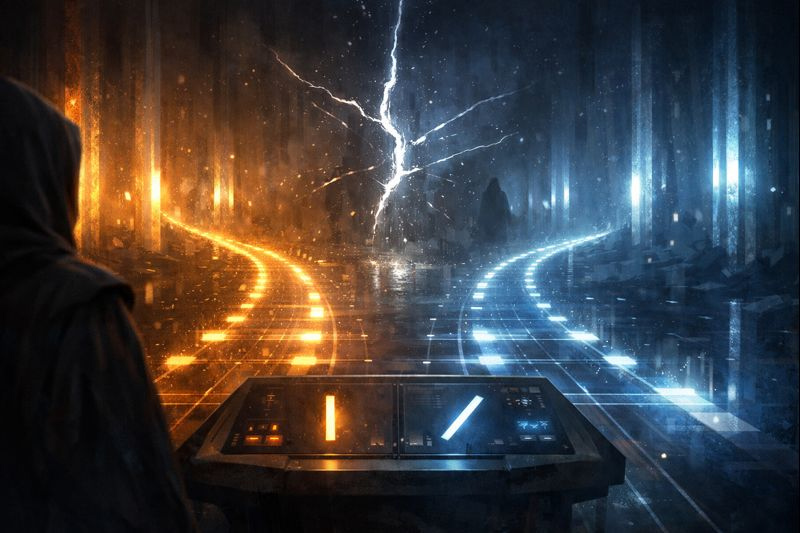
The console’s surface reconfigured into a grid—clean lines, evenly spaced—then immediately broke its own symmetry. Two lanes appeared, parallel at first, then diverging. Each lane carried its own timing marks.
One tempo matched the rhythm in my chest: imperfect, human, breathing. The other tempo matched the interference: precise, persuasive, slightly cold— like it wanted to win by being undeniable.
The crack widened again and a thin shadow passed behind it, too fast to name. The counter-rhythm tried to lock onto the bass, to steal the grounding, to make my downbeat its downbeat.
Instinct said: push harder. Turn it up. Overpower it. But the chamber made it clear that force would only feed the mismatch.
I closed my eyes. Not to escape—just to hear without seeing.
Beneath everything, under the layers and the shimmer, there was a tiny pulse I’d missed before: a quiet click like a clockwork tooth catching at the exact start of each bar. Not music—structure. The place’s true metronome.
I breathed with it. Once. Twice. Letting the chest-rhythm soften until it could sit on the grid instead of fighting it.
The console warmed under my palm, responding. The lanes on the grid shifted, seeking coherence. The interference reacted immediately—swinging wider, trying to pull the timing off-center again.
The figure leaned in, just slightly. “Choose what you anchor to,” they said. “Your tempo, or the room’s.”
The crack pulsed like it heard them. Like it understood the terms.
On the console, two glyphs surfaced—simple and final: one shaped like a steady vertical line, the other like a slanted one, drifting out of phase.
The chamber waited for the smallest decision to become the next measure: lock to the metronome… or ride the sway.
I didn’t reach for either glyph. I stayed where I was.
The metronome beneath the chamber ticked again—quiet, unannounced. I let my breath fall into it, not forcing alignment, just allowing the space between pulses to exist without commentary.
The vertical line brightened—not suddenly, not triumphantly—but with the calm certainty of something being acknowledged rather than chosen. The slanted glyph continued to drift, searching for friction that never arrived.
The interference hesitated. That was its mistake.
Without resistance to push against, the counter-rhythm lost its edge. Its precision unraveled into ornament. Timing marks slid out of relevance. The crack in the air thinned—not sealing, just… forgetting why it was there.
The chamber didn’t correct it. It simply stopped responding.
One by one, the columns of light dimmed to a softer state—no longer broadcasting, no longer amplifying. The grid on the console simplified, shedding subdivisions until only the essential structure remained.
Bass receded. Midrange cleared. The crystalline thread slackened, no longer pulling.
What remained wasn’t silence. It was coherence.
The figure exhaled—a soundless gesture, but unmistakable. “You didn’t dominate the signal,” they said. “You declined to wrestle with it.”
The clearing beyond the chamber bled back into view, layered timelines folding inward like tracks being muted one at a time. The city-glow below dimmed. The unfamiliar structures dissolved into suggestion.
Only the forest remained. Trees. Moss. Moonlight.
The console lowered itself back into the ground, surface cooling, interface becoming stone again. No shutdown tone. No confirmation. Just completion.
“This measure holds,” the figure said. “For now.”
“What happens next?” I asked.
They gestured toward the treeline, where a narrow path had reappeared— darker than before, less luminous, but unmistakably real. “Now you walk with it,” they said. “Without the room to tell you when you’re right.”
The motes in the air settled into the ground like embers cooling. The hum faded until it was indistinguishable from wind in leaves.
As I stepped toward the path, I realized the rhythm hadn’t left. It had just stopped announcing itself.
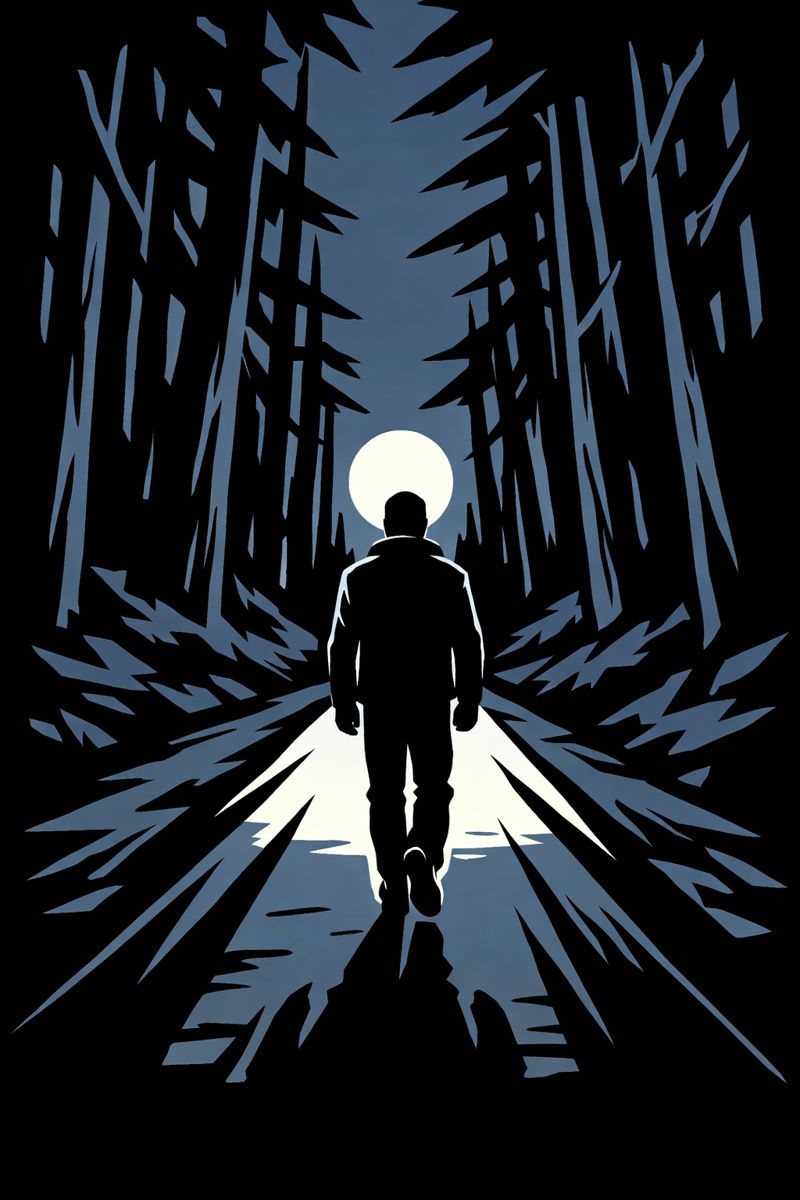
The path didn’t glow anymore. That was the first thing I noticed.
It was just earth and pine needles now, darker where the moon couldn’t quite reach, uneven in a way that asked for attention. Roots crossed it without apology. Stones waited to be stepped on or around.
I adjusted my pace without thinking. Not slower—more precise.
Each footfall landed where it needed to, not where it was easiest. The forest no longer arranged itself around me, but it didn’t resist either. We had moved into a quieter agreement.
Behind me, I felt the clearing settle fully—no presence watching, no signal listening. Whatever threshold I’d crossed had closed without ceremony.
The rhythm was still there. Not audible. Not insistent.
It lived in small things now: the timing of my breath, the way my shoulders loosened on an exhale, the instinctive pause before stepping into shadow. The kind of tempo you only notice when it’s gone wrong.
A memory surfaced—standing at the edge of the lake earlier that night, watching the paper boat thin into light. I understood it differently now. It hadn’t disappeared. It had transferred.
The forest opened gradually, not into a clearing, but into familiarity. The dock reappeared between the trees, pale under moonlight, exactly where it had always been.
The lake was calm again. Just water. Just reflection.
I stood at the edge and waited for something—confirmation, echo, response. Nothing came.
That was the point.
The rhythm didn’t belong to the lake. Or the forest. Or the chamber that no longer existed.
It belonged to the way I would move through whatever came next—days, conversations, work left unfinished, choices that wouldn’t announce themselves as choices.
I turned away from the water.
Behind me, the moon’s reflection broke into fragments with the smallest disturbance—ripples from a night breeze, nothing more. The surface didn’t try to hold an image.
As I walked back toward whatever counted as morning, I realized something simple and irreversible: I wouldn’t need to find the rhythm again. I’d know when I was out of it.
Morning arrived like it had something to prove.
The sky was pale and honest. Birds did what birds do. The lake lay still, unbothered by the fact that it had been a doorway hours ago. I expected the world to feel different—charged, altered, announcing itself.
It didn’t. That was the first spin.
The second came when I checked my phone. No signal bars. No warnings. Just the time, perfectly normal—except the seconds weren’t moving. The digits held like a frozen loop, a beat that refused to advance.
I blinked. The seconds jumped forward in a sudden burst, catching up as if the device had been embarrassed to be caught.
I laughed once—quietly—because it felt ridiculous that the first proof of last night would show up as something so small, so boring, so everyday.
I walked toward the dock anyway. The boards looked the same, but my feet heard them differently. Each step landed with a gentle certainty, like my body was still following a grid that wasn’t visible anymore.
At the end of the dock, the water reflected the day without opinion—clouds, treeline, my face. No silver corridor. No seam.
Then—just for a half-beat—the reflection lagged.
Not much. A fraction. A tiny delay, like a video buffer hiccuping. My hand lifted, and my mirrored hand followed a blink late.
The lake corrected itself instantly, smoothing over the mistake as if it hadn’t happened. But I’d felt it. The world had felt it.
I remembered the figure’s voice without hearing it: Now you walk with it… without the room to tell you when you’re right.
Maybe the room was gone, but the rules were still threaded through things. Not in glowing paths or singing columns—just in timing.
I looked down at my palm. There was no mark. No symbol. Nothing cinematic. Just skin, warmed by sun.
And yet my hand felt… slightly heavier. Like it had picked up a tool I couldn’t put down.
On the shoreline, a scrap of paper nudged the reeds—waterlogged, folded, stubbornly intact. I reached for it and unfolded it carefully.
It wasn’t a list. It wasn’t even my handwriting.
It was a single line, printed cleanly as if it had come from a machine: PLAY THE DAY IN.
The breeze picked up, and the lake broke the sunlight into pieces. For a moment it looked like glitter—ordinary, harmless. But I knew better now. The signal didn’t need the night anymore. It had learned how to hide in daylight.